
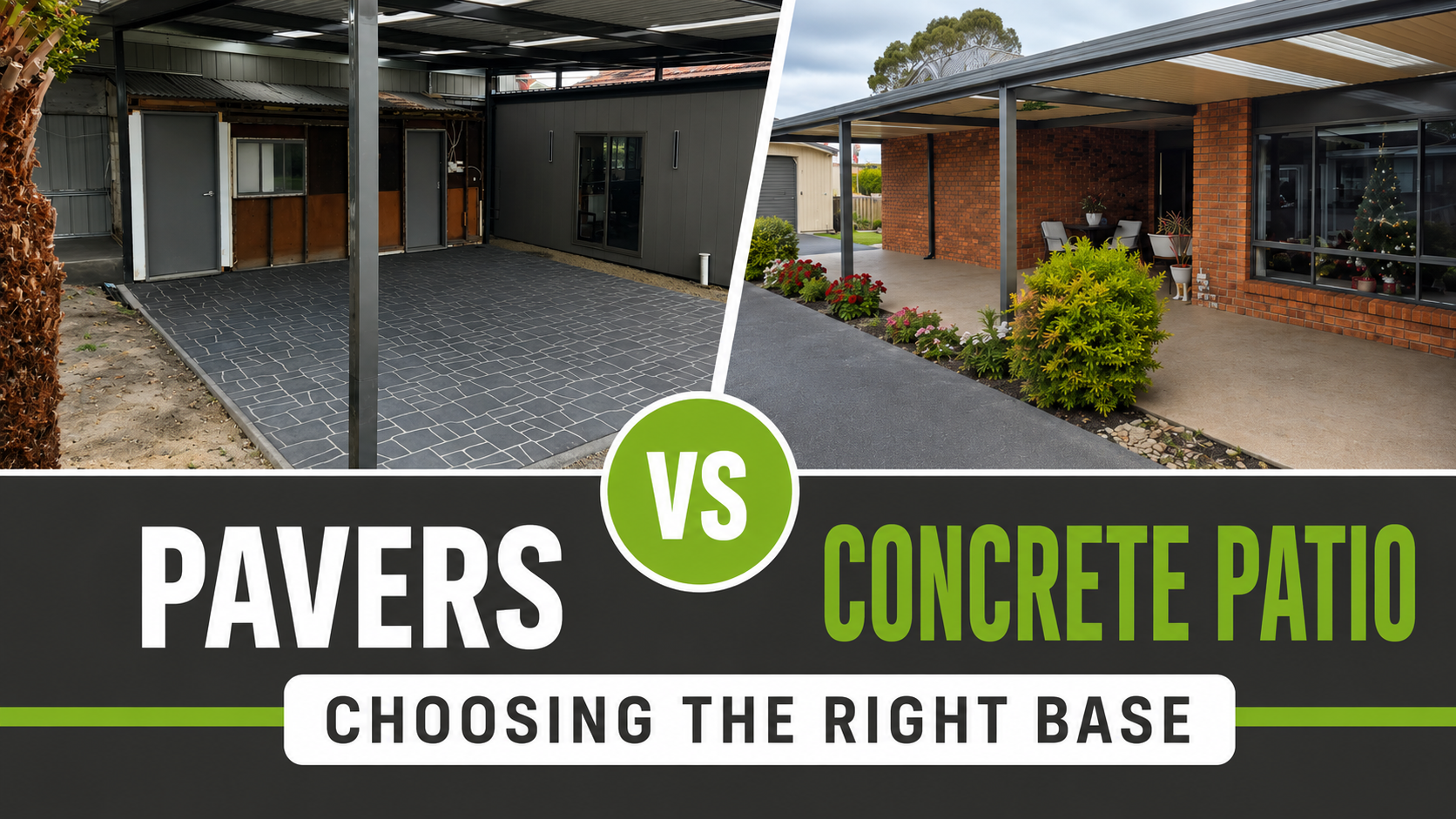
Pavers vs Concrete Patio: Choosing the Right Base for Your Home
Pavers, concrete, or decking might be a long-running conversation at many homeowners' kitchen tables right now.
The goal is a usable outdoor space. It needs to handle long mornings, family dinners, and the kind of daily life a patio should support. The pavers vs concrete patio question shows up early in the planning. And the answer shapes more than just the look of the finished area.
None of them is actually the best.
35+
Google Reviews
Verified 5-star reviews from Gippsland homeowners via Trustmary
3D
Design Modelling
See exactly how your structure will look on your home before you commit
E2E
Permit Handling
Council approvals managed end-to-end. No paperwork headaches for you
DB-U
Registered Builder
Colin Beer, DB-Unlimited 12691, registered builder on every project
The right option suits your home, your block, and how you actually live in the outdoor space. Paver companies will tell you pavers are the answer, since pavers are what they install. Concrete suppliers will steer you towards a slab for the same reason. Neither perspective knows the property or the way the family will use it. Our years of building patios and verandahs across Gippsland point to a different answer.
A clearer path comes from knowing what each option actually asks of you.
This guide walks through the decision the way a registered builder would. We cover what each surface does well and where it falls short. We explain how the base underneath shapes everything sitting on top. The aim is to help you choose with clarity instead of doubt.
Pavers VS Concrete VS Decking: How They Compare
A side-by-side view often clears up more than another long article.
The table below isn't there to crown a winner. It's there to show how each option behaves across the five factors most homeowners weigh first.
When you compare pavers vs concrete and decking on equal terms, the picture changes. The patio pavers vs concrete slab debate stops feeling like a verdict. Instead, it becomes a question of which surface fits the home.
Factor | Pavers | Poured Concrete | Decking |
|---|---|---|---|
Lifespan | 30+ years | 20–25 years | 15–25 years |
Repair | Replace individual units | Bright interiors, period homes | Replace boards |
Cracking | Flexes with ground movement | Prone to cracking | N/A |
Design variet | Very high | Limited (more with stamped) | Moderate |
Slip resistance | Good | Slippery when wet | Good (varies) |
Understanding The Three Main Surface Options
Before going deeper, here's what each surface actually is in plain terms.
Paver Patios
A paver patio is built from individual units laid across a prepared base. As stated by Tile Tech Pavers, pavers come in a wide range of options. From concrete pavers and brick pavers through to porcelain pavers and natural stone pavers.
Stone pavers in particular suit homes with traditional finishes. Patio pavers are available in many sizes, shapes, and styles to match the home.
Poured Concrete
Poured concrete is laid as a single connected concrete slab across the patio area. Standard concrete gives the baseline finish, smooth and uniform once cured.
Stamped concrete adds texture and pattern, while stained concrete brings colour into the surface itself. Sealed concrete protects the finish from staining and weather over time.
The whole slab moves and ages as a single piece.
Decking
Decking sits as the raised alternative to a paver patio or poured slab. Rather than rest on a sand bed or compacted base, a deck is built on footings. It has bearers and joists supporting the boards above.
Ventilation underneath protects the timber and helps with drainage. Timber decks bring warmth to the space. Lastly, composite decking offers a lower-maintenance option for homes near the coast or in shaded zones.
Pros and Cons of Pavers and Concrete and Decking on the Decisions Which Matter
These four factors carry most of the weight when choosing between pavers, concrete, and decking.
Cost: Initial and Over Time
Concrete is generally the cheaper option in terms of initial cost. The cost of concrete is often 30 to 60 percent cheaper than pavers per square metre on a typical patio job. Concrete is also faster to install, which keeps labour costs down.
Pavers are more expensive partly because paver installation is labour-heavy. It includes base prep, bedding, edge restraint, and individual unit placement, all adding time. According to Solbreeze Concrete, "Installing each block individually is time-consuming and adds to the cost."
The price difference is real, but it isn't the whole story.
When you compare pavers and concrete on a specific job, the cost depends on more than the materials. Site access, slope, base depth, and removal of any existing surface all change pavers' cost. No two jobs end up with quite the same number.
A clean level block with good access keeps the gap smaller than a tight sloped site with poor drainage. The numbers in a quote always reflect more than just the material itself.
Durability and Longevity
Pavers are generally stronger than concrete under ground movement. The reason is structural rather than material.
Unlike a concrete slab, a paver surface is made of individual units with flexible joints. Those joints absorb settling and minor shifts in the ground, which keeps the surface intact. A concrete slab, in contrast, is prone to cracking when the soil beneath it moves or expands.
This difference shows up in real lifespan numbers, too.
Pavers can last longer than concrete in many Gippsland conditions. It often pushes 30 years or more when properly installed. Concrete typically lasts 20 to 25 years before visible cracking or surface failure starts to show. Pavers are highly durable as a system, and compared to concrete, they age more gracefully across the seasons.
Maintenance and Repair
Maintenance varies more than most homeowners expect across the three options. Composite decking and sealed concrete sit at the low-maintenance end. Pavers carry slightly lower maintenance demand. This is mostly because joint sand and weed control need attention every few years.
The bigger difference between pavers and concrete shows up in repair.
A paver surface is easier to repair than a concrete slab. Individual units can be lifted, the base adjusted, and the paver reset in place. A patched section of concrete rarely looks like concrete around it. Installing pavers takes longer at the start, but it usually means less maintenance regret over the years.
Design, Aesthetic Appeal and How It Sits on Your Home
Aesthetic appeal pulls the three options apart more than any other factor. Patio pavers offer the widest design flexibility across colour, texture, and pattern. Concrete offers more limited design options unless stamped or stained, where it can mimic a paver look at lower cost.
Pavers provide more curb appeal for homes with character. Natural stone pavers and brick pavers create unique designs, with finishes able to mirror the home's existing materials. Pavers offer better slip resistance underfoot too.
A patio surface should look like it was always meant to belong to the home, not bolted on afterwards. The right material choice carries more design weight than most homeowners realise until the build is finished.
Which one do you think fits your home? Let’s talk.
Choosing the Right Patio Base in Australia
The base matters as much as the surface above it. Most regret outcomes from patio builds actually start underground. The wrong prep means even the most beautiful surface fails within a few years. Choosing the right patio base is what gives the finished area its real lifespan.
What goes underneath depends on what's going on top.
For paved surfaces, the best patio base in Australia is typically 75 to 100mm of compacted road base. A 20 to 30mm layer of coarse sand bedding sits on top for the pavers to bed into. Different patio base options apply to different surfaces.
A poured concrete slab needs its own prep with compaction, formwork, and reinforcement. Decking sits on footings rather than a slab, with bearers and joists supporting the boards.
Pavers may sometimes be laid over existing concrete if the slab is sound and drainage is right.
Geotextile fabric, plate compaction in thin layers, and edge restraint extending past the surface all matter. Skip any one of those, and the result fails before the surface itself even gets a chance. None of this work shows in the finished photos, but every long-lasting patio is built on it.
How Your Patio Surface Affects What You Build Above
The patio surface decision doesn't end at ground level. What sits above shapes which surface actually works best below.
A pergola, patio roof, or verandah each introduces different demands on the surface underneath. Post footings, drainage from above, and visual integration with the home all change with the structure overhead.
Pavers adapt to future changes more easily than concrete or decking. Sections can be lifted if a post needs to go in later or a footing has to be adjusted in place. This flexibility works well for staged builds. It makes them ideal for homes still planning their outdoor living over several years.
Concrete is fixed and stable, which suits a verandah unlikely to move. Decking has its own structural rules around post lines and ventilation. Picking a surface without considering what sits above is an expensive mistake a homeowner makes.
When to Choose Pavers, Concrete or Decking
When to Choose Pavers
Choose pavers when ground movement or future changes matter most. Use pavers where soil shifts seasonally, since the surface flexes rather than fractures. Pavers often suit homes where the patio integrates with garden beds. Pavers typically last longer than concrete in active soils. Go with pavers if the build may extend later into a pergola.
When Concrete is the Best Choice
Concrete wins on simplicity. The pros and cons of pavers and concrete come down to flexibility versus uniformity. Pavers offer flexibility. Concrete offers a single surface with fewer joints, fewer plants in the cracks, and fewer maintenance moments.
According to Community Concrete, "concrete only needs occasional sweeping and washing to stay clean. " When the pavers or concrete decision feels close, concrete is the better choice for a formal alfresco. It's under a fixed roof, tighter budgets, or simplicity-first households.
When Decking is the Better Choice
Decking is the better choice on raised sites, sloped blocks, or areas where deep excavation isn't practical. A timber or composite deck handles uneven ground more gracefully than pavers or concrete. It adjusts through the substructure rather than the surface.
Traditional verandah integration is another decking strength. This is due to the fact that timber matches the look of period homes more than a paved or concrete finish.
Other Concrete Patio Alternatives
Concrete patio alternatives go beyond pavers and decking. Gravel, decomposed granite, flagstone, and resin-bound surfaces all offer a different kind of finish underfoot. Each one also doubles as a driveway material in many homes.
Each alternative carries its own trade-offs around drainage, comfort, and longevity. Villafab focuses on the structures above the surface, like pergolas, verandahs, and patio roofs. Specialist installers typically handle these finishes rather than a custom outdoor builder.
5.0
★★★★★ Google Rating
35+ verified reviews via Trustmary
★★★★★
We are very happy with our new Carport, Sunroom and Veranda! Colin and Gerry are true professionals with an eye for detail and craftsmanship. They worked seamlessly with all the others tradies on site to deliver a beautiful result on time and on budget. We recommend them very highly!
Argyro G.
★★★★★
A big thankyou to both Colin and Jerry for organising / building our pergola. - It looks fantastic and only took a couple of days to put up. They handled all the paperwork (permit applications, etc.) and just took any stress out of the process. Very clear communication, professional and at a reasonable price. Honestly, would recommend these guys to anyone and very happy with the end result. 
David
★★★★★
We love our patio.. great work to colin and gerry.. you did a great job. You guys are great to talk too.. The workmanship you did on the patio was 100%.. We have had a patio done before, with another company wasn't as great workmanship as this one.. We are both already enjoying it.. Thanks again Colin..
Kerry L.
★★★★★
Easy to talk too, conscience & work completed in a timely manner. Highly recommend.
Dianne T.
Neither one is universally better, since each suits a different home and household. Pavers offer more design flexibility and tend to last longer in shifting soil. Concrete delivers a uniform finish at a lower upfront cost in most jobs. The right answer depends on the home, the budget, and what gets built above the surface.
Concrete is generally cheaper on initial cost, often by 20 to 40 percent per square metre. Pavers cost more upfront because the labour is higher and the base prep is more detailed. Over a 20-year horizon, the cost gap can narrow. Repairs and resurfacing for either surface eventually factor into the overall spend.
A verandah is roofed and attached to the home. A pergola has an open or partly open roof and is often freestanding. One is built for year-round use. The other defines an outdoor space without committing to full shelter.
In most Gippsland conditions, paver patios do tend to last longer than concrete. Pavers typically last 30 years or more when properly installed. A poured concrete slab usually lasts 20 to 25 years before visible cracking shows. The flexible joints between pavers absorb ground movement over the seasons. A concrete slab cracks as one piece when the soil beneath shifts.
Pavers offer the most flexibility under a pergola or patio roof. Sections can be lifted later if a post or footing needs adjusting. Concrete works well for fixed verandah builds where the structure won't change. The right surface depends on which structure you're building and how settled the design is.
The Honest Answer on Pavers, Concrete and Decking
The loudest answer in a search result is rarely the right one for your home.
Pavers, concrete, and decking each suit a different home and a different way of living. The decision comes down to soil, design, budget, and the structure above. None of the three is universally better; the right one suits this home, this block, and this household.
Seeing the design clearly before committing is what makes the difference.
Villafab is built for Gippsland homes, Gippsland weather, and Gippsland blocks. A registered builder who has seen what works and what doesn't makes this kind of decision easier. The right surface and structure above turn an outdoor space into a real part of the home.
See it clearly. Build it properly.
The first step is a conversation, no pressure, no hard sell. Tell us about your home and outdoor space. We'll help you work out the right fit and what it would realistically look like.